 eShop
eShop
 English

In biological experiments, ultrafiltration is a powerful tool for concentration, desalination, and buffer exchange. With four available sizes (0.5 mL, 2 mL, 4 mL, 15 mL) and seven molecular weight cut-off (MWCO) options (2 kDa, 3 kDa, 10 kDa, 30 kDa, 50 kDa, 100kDa, 300 kDa), selecting the most suitable centrifugal filter is critical to experimental success.
Part 1: Size Selection Guide
1.1 Principles for Choosing Filter Size
Select the appropriate centrifugal filter size based on your starting sample volume and throughput requirements. The design of each size determines its application scenario:

- 0.5 mL Centrifugal Filter – For Precious, Low-Volume Samples
Typical applications: Valuable samples, small starting volumes (<500 μL), high recovery required; compatible with standard 1.5/2 mL fixed-angle rotors.
Operating features: Two-tube design (concentrator + collection tube). After centrifugation, the concentrator tube is inverted and centrifuged at low speed to transfer the retentate into the collection tube, minimizing dead volume and adsorption loss.
Key parameters: Final concentrate volume approx. 15–30 μL; maximum centrifugal force up to 14,000 xg.

- 2 mL Centrifugal Filter – Adaptable to Standard Centrifuges
Typical applications: Compatible with rotors or adapters that hold 15 mL conical tubes; suitable for both swing-bucket and fixed-angle rotors; routine protein concentration.
Operating features: Three-piece design (ultrafiltration device + retentate tube + filtrate tube). Inverted recovery required. Designed for sample volumes up to 2 mL, yielding final volumes of 30–70 μL.

- 4 mL Centrifugal Filter – Medium Throughput
Typical applications: Processing about 4 mL of sample; suitable for lab centrifuges with swing-bucket or fixed-angle rotors.
Operating features: Consists of cap + ultrafiltration device + centrifuge tube. No inversion needed – directly insert a pipette tip along the sidewall to withdraw the concentrate from the inner tube bottom (recovery volume 80–200 μL). More convenient to operate than the 0.5 mL and 2 mL sizes.

- 15 mL Centrifugal Filter – Large-Volume Preparations
Typical applications: Large-scale sample preparation, e.g., protein/antibody processing, nucleic acid and virus concentration.
Operating features: Compatible with high-capacity centrifuges. Maximum loading volume up to 15 mL (swing-bucket) or 12 mL (fixed-angle). Recovery volume 150–300 μL. Direct pipetting recovery – avoid scratching the membrane surface when withdrawing.
Part 2: MWCO Selection Guide
2.1 Principles for Choosing MWCO
Golden Rule: To achieve optimal retention, select a filter membrane with an MWCO that is 2 to 3 times smaller than the molecular weight of the solute you wish to concentrate.
2.2 Application Selection Quick Reference Table
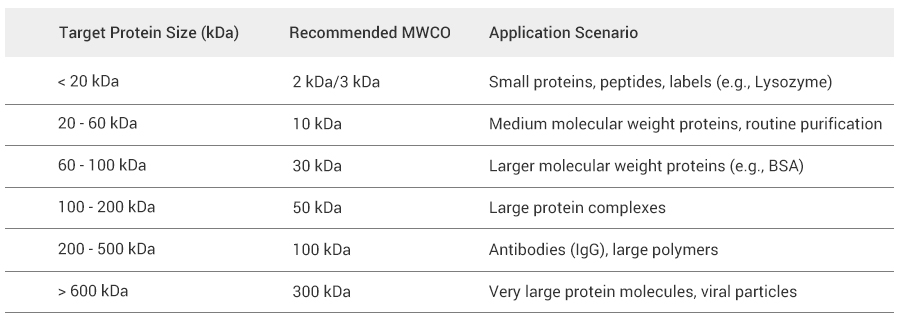
- Protein Application Selection Table
*For concentration and buffer exchange of antibodies, enzymes, antigens, and similar samples
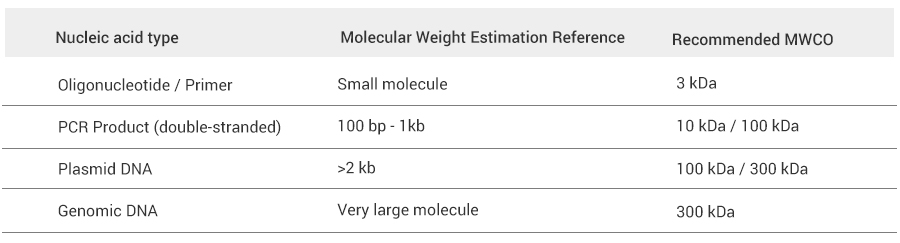
- Nucleic Acid Application Selection Table
*For concentration and desalting of DNA, RNA, and plasmids
Special Application Recommendations
Desalting and Buffer Exchange: 3 kDa, 10 kDa, or 30 kDa is recommended. This is based on the principle that small‑molecule salts pass through the membrane while large‑molecule proteins are retained.
Virus Concentration / Removal: 100 kDa or 300 kDa is recommended. Used to isolate virus particles from cell lysates.
Primer / Adapter Removal: 30 kDa or 50 kDa is recommended. Used for post‑reaction purification in molecular biology to remove small‑fragment impurities.
Part 3: Experimental Precautions
3.1 Operational Precautions
Once the ultrafiltration membrane is wetted, it must be kept wet until use is completed.
3.2 Centrifugal Force Control
The 0.5 mL size has the highest tolerance (up to 14,000 xg).
For the 4 mL and 15 mL sizes, when using 100K and 300K large‑pore membranes, the centrifugal force should be appropriately reduced (e.g., for 100 kDa, ≤3,000 xg is recommended) to avoid damaging the membrane structure.
3.3 Chemical Compatibility
The Briscale™ series exhibits good compatibility with common buffers, 8 M urea, 6 M guanidine hydrochloride, 70% ethanol, etc. However, when using reagents such as DMSO, it is recommended to limit contact time to within 2 hours.
Conclusion
choosing the right centrifugal filter makes your experiments more efficient and effective. We hope this selection guide based on the Cobetter Briscale™ product line helps you precisely target your molecules of interest, making every centrifugation highly efficient and high‑recovery!


